4-stage sales method
This method is not some new invention; rather, it is the result of experience gained throughout my career—especially from the lessons learned through my own failures—combined with common sense.
Like any method, mine can be improved. I am constantly working to refine it.
It consists of four stages:
1. Launching
2. Prospecting
3. Selling
4. Closing
Tasks:
- Signing of a partnership agreement between your company and me. I have a contract template for this purpose (if your company considers this option).
- Training on your company's services and products is necessary to help me to sell them to qualified potential clients.
- I have many years of experience in technical and marketing writing and can develop sales/marketing materials from scratch and/or contribute to the adaptation/improvement of existing ones.
This phase is expected to take two (2) weeks, beginning on «Day One».
Day One is the date the partnership agreement between your company and me is signed (the effective start date of my sales plan).
Launching
Tasks:
- Proactively seek out potential clients who have already been identified and qualified to generate interest in your company's products and services.
- Provide your company with ongoing updates on prospecting performance.
- Use industry-standard lead qualification frameworks, such as BANT and MEDDPICC, to ensure that only genuine opportunities enter the sales pipeline and avoid «false positives».
This stage is estimated to take two (2) weeks, starting from Day One and continuing thereafter.
Prospecting
Selling
Tasks:
- Sales presentations and demonstrations of your company's solutions are conducted for pre-qualified prospects, where appropriate.
- I prepare customized technical and financial proposals. I do this for qualified prospects.
- Where applicable, proofs of concept (POCs) are carried out by me as part of pre-sales activities to close deals. My hybrid profile, which combines a technical background with a specialization in sales and marketing, allows me to fulfill both technical sales support and pre-sales roles. This reduces personnel costs for your company while accelerating sales cycles.
This stage is estimated to take ten (10) weeks, starting from Day One.
Closing
Tasks:
- At this stage, I conduct contract negotiations with qualified prospects. I do so in collaboration with your company. This is done to finalize the engagement for the solutions offered.
- This is done to finalize the engagement for the solutions offered. Your company's relevant policies are incorporated by these agreements.
- My more than 25 years of experience in these types of engagements will help expedite the process.
This stage is estimated to take twenty eight (28) weeks, starting from Day One.
The development of the four stages of the method is shown in this Gantt chart.
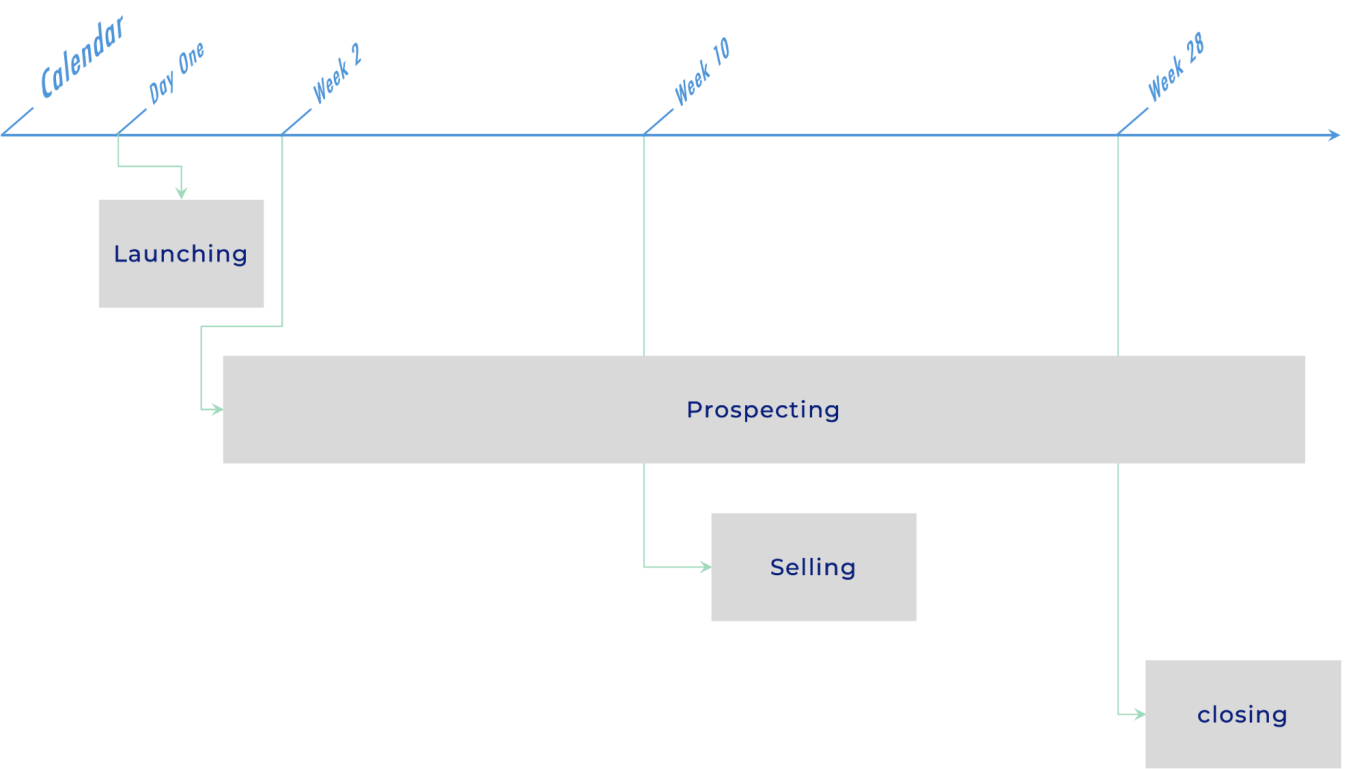
As you can see, the «Launching» phase begins when the partnership agreement is signed and should take no more than two weeks.
The «Prospecting» phase begins once I have received general training on your company's solutions. This phase continues indefinitely because prospecting is an ongoing task.
The «Selling» phase begins as soon as possible, sometimes within two or three weeks of «Day One». To be conservative, I have estimated a ten-week timeframe from «Day One» for this phase to begin.
I have also taken a conservative approach in estimating the start of the «Closing» phase: 28 weeks from «Day One».
In reality, prospecting, selling, and closing are continuous tasks that begin the moment a prospect interested in your company's solutions is identified.
In other words, we constantly prospect to uncover sales opportunities, sell to qualified prospects, and finalize deals with those who have reached the closing stage.
Sectors where I sell in my core territory: Spanish-speaking Latin American countries (non-exhaustive list)
Agriculture / Livestock / Poultry farming / Aquaculture / Forestry industry
· Vineyards
· Cereals and other crops
· Intensive agriculture
· Large-scale livestock farms
· Large-scale agricultural holdings
· Large-scale poultry farms
· Forestry
· Forestry plantations
· Salmon farms
· Shrimp farms
Industry
· Food and beverages
· Chemical products
· Pharmaceuticals
· Metal
· Plastics
· Home appliances
· Construction materials
· Machinery
· Automotive
Services and Logistics
· Passenger transport companies (buses, trains, airplanes, ships)
· Freight transport companies (air, sea, land)
· Hospitals and clinics
· Insurance companies
· Financial services companies
· Cooperatives
Utilities
· Electricity generators and distributors
· Water and sewage treatment companies
· Oil and gas generators and distributors
· Renewable energy generators and distributors
Technologies where I have knowledge and sales skills (non-exhaustive list)
· IoT & IIoT (Internet of Things and Industrial Internet of Things) platforms
· SCADA (Supervisory Control And Data Acquisition) systems
· ERP and CRM systems
· GRC (Governance, Risk management and Compliance) software
· SSD (Single Sign On), IGA (Identity Governance and Administration) software
· Telecommunications equipment and end-to-end platforms (terrestrial and satellite)
· IT-related services (software development, ethical hacking, data centers management)
· Vertical applications (software and hardware)
My competitive advantage
I have always believed in and applied the principle that ethics is good business.
What do I mean by this?
In every area of our lives—especially in business—when we aim to sell a product or service, it must deliver on our promises.
The purpose of this website is to persuade your company to hire my sales services.
Next, I will highlight my strengths and assure you that my weaknesses will not jeopardize the success of my sales work.
Here are my strengths:
Mixed profile
I am a technician by training and a salesperson by vocation.
My technical background allows me to grasp the intricacies of any technology.
My professional experience allows me to synthesize information and present it in a way that is easily understood by the intended audience.
This key strength—my hybrid profile—offers the companies that hire me two distinct advantages:
(1) Greater efficiency. When presenting to potential clients, I explain the value of your company's solutions
in a way that my audience can understand. For technical staff, I explain how the solutions work and
how they outperform the competition. For executives, such as financial managers, purchasing
managers, and CEOs, I explain the benefits the solutions bring to their business. I don’t need to ask the
client’s technical team for a couple of days to respond to a question that I would otherwise be unable to
answer without a technical background. This increases operational efficiency while strengthening the
client’s confidence in me.
(2) Lower cost. A pre-sales support technician and a salesperson represent two distinct roles, each
requiring appropriate compensation for their work. By combining both roles into a single individual
(myself), your company only has to pay for one position. Furthermore, my compensation is very low, as I
explain in Section 6.
Languages
I am practically bilingual in English.
Having lived and worked in Israel for about 12 years, I am also practically bilingual in Hebrew.
The advantage this strength offers your company is clear: I can carry out sales work not only in Spanish-speaking countries but also globally.
My professional experience in Israel has given me the ability to communicate in Hebrew, the local language. I also have a deep understanding of Israeli culture and the Israeli mindset.
This allows me to sell your company's solutions also in Israel, should your company wish to pursue this as an additional opportunity.
Technical, commercial, and contractual writing
I have approximately 30 years of experience developing technical materials, like manuals, user guides, and tutorials, as well as commercial materials, such as sales presentations and brochures.
One of my strengths is my ability to articulate ideas and craft messages so that the intended audience fully grasps them. This is not an exaggeration, but rather a fact that you will be able to verify firsthand should you choose to engage my services.
While I am not a lawyer, I draft contracts when needed, such as non-disclosure and business partnership agreements, which are usually accepted by legal counsel with minimal modification, if any. This may not directly relate to my sales methodology, but it often accelerates the negotiation and closing phases of agreements with clients and distribution channels.
Over 30 years of sales experience
More than 30 years ago, I transitioned from a career in technical work to sales.
I had a great "training ground." I started at a software distribution company in Buenos Aires, my hometown. The company had ten employees: three secretaries, three technicians, one administrative staff member, and one general manager. The sales department consisted of two people: a senior salesperson and me, the junior salesperson.
We sold software systems from a U.S.-based ISV (independent software vendor). This term was used for small-to-medium-sized enterprises that dared to compete against the "Goliath" of that era, IBM. This was before Google, Meta, and the SAP and Oracle we know today existed.
IBM considered the systems we sold to be strategic. If you’re curious, look up the pivotal role these flagship IBM products played for their clients, which were all large organizations. Only major companies could afford to invest millions of dollars in IBM-equipped mainframes and data centers such as NetView, DB2, and CSP (Cross System Product). My job was to sell three software products from Cincom Systems, the U.S. ISV that we represented in Argentina.
These products competed directly with the three strategic IBM products: Net/Master (against NetView), Supra (against DB2), and Mantis (against CSP).
In other words, each copy of Net/Master, Supra, or Mantis purchased by clients such as Siemens, Fiat, Peugeot, the Central Bank of Argentina, and BBVA Argentina represented a sale that IBM's sales force had failed to secure for their own products. NetView, DB2, and CSP.
This hurt not only the annual sales quotas of IBM's salespeople, but also weakened IBM's dominant competitive position in the market. IBM provided its major clients with everything they needed: mainframes, operating systems, disk drives, printers, controllers, databases, and other software.
What happened during the early years of my sales career?
In some instances, it was a classic «David versus Goliath» story: Two salespeople from a ten-person company beat IBM. Large clients opted for Net/Master, Supra, or Mantis instead of NetView, DB2, or CSP.
Why am I sharing such detailed accounts of my early days in sales?
Because this story illustrates the message I want to convey to your company.
I have experience selling solutions from «David» companies competing against «Goliath» corporations.
I know how to capture the attention and interest of qualified prospects for an unknown or little-known product or service offered by a newcomer (or a company with a limited track record) in a given market.
I know how to highlight the competitive advantage—and thus the unique value—of the solution I am selling compared to the competition, even when that competitor is a «Goliath».
I have over 30 years of experience selling in the Spanish-speaking countries of Latin America.
My compensation model
Before I describe my compensation structure, I would like to clarify something.
I never work solely based on sales commissions or any other form of income tied exclusively to sales, such as margins added to the amount a hiring company expects to receive from a sale.
In other words, I do not work on a «success-only» basis.
I am compensated for every sale that is closed and paid for by customers to the hiring company. This compensation comes in the form of either (a) a sales commission, if your company uses a fixed price list from which salespeople earn a specific percentage, or (b) a margin added to the amount your company expects to receive from a sale, if each sale is treated as an individual project, with costs and profit margins calculated on a project-by-project basis.
I only receive compensation when a sale is closed and paid for. I will refer to this variable compensation as «VC» for short.
In addition to my VC, I charge a monthly net fee («MNF», for short) of €2,100 (two thousand one hundred euros per month).
I will continue to invoice the MNF until my monthly variable income (i.e., VC for a given month) reaches or exceeds the MNF.
As soon as my VC equals or exceeds my MNF, I stop invoicing the MNF.
So, when will I stop invoicing this monthly net fee?
Answer:
I stop billing the monthly net fee (MNF) and begin earning only my variable commission (VC) when my monthly sales revenue generates a VC amount equal to (or greater than) €2,100 net.
In this way, I represent a fixed monthly cost for your company for a limited period.
Why do I charge this MNF?
Answer:
Because in addition to selling the most valuable asset a person possesses—time—I offer something that money cannot buy: over 30 years of experience building trusting relationships with clients and distribution channels with whom I have worked and continue to work on various projects.
These clients and channels already know and trust me.
I can easily reach the right people because of my extensive, ongoing sales experience within the target market. This shortens pre-sales cycles, thereby accelerating the time it takes to begin generating revenue and growing sales.
This offers real value, and I've set an affordable monthly fee for your company. Considering the multiple benefits and competitive advantages I outlined above, I'd think this is a great deal.
My role goes beyond the standard tasks of an international business developer, though they are certainly included. Thanks to my hybrid technical and commercial background, it also encompasses pre-sales technical support and technical and commercial copywriting whenever such tasks help us achieve our objectives.
In short, I combine three distinct roles (paid roles)—and the compensation typically associated with each—into one role at one price.
To support my claim of an exceptionally low cost, consider just one of these roles: senior-level business developer.
A quick look at various sources, such as Glassdoor, confirms this.
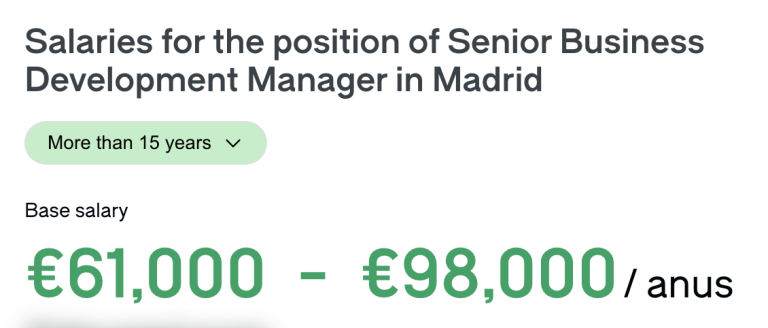
Source: https://www.glassdoor.es/Salaries/madrid-spain-senior-business-development-manager-salary-SRCH_IL.0,12_IM1030_KO13,48.htm?countryRedirect=true
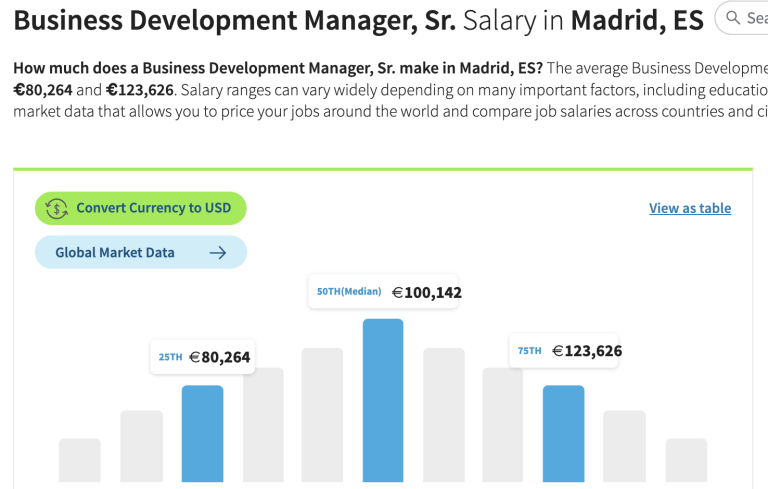
Source: https://www.salary.com/research/es-salary/benchmark/business-development-manager-sr-salary/es/madrid
Furthermore, my monthly net fee (MNF), in addition of being temporary (as explained above), represents the entirety of the fixed cost for your company, as I entail none of the typical direct or indirect labor costs, such as social security contributions, paid vacation, paid sick leave, equipment (mobile phone, computer, etc.), or severance pay.
I conclude this section by quoting one of the pioneers of modern management:
«The best way to predict the future is to create it».
—Peter F. Drucker