
Leaders, Challengers and Survivors
Companies on this planet can be one of these three groups:
- Leaders. A company whose market share (in sales volumes) is much higher than competition's. Their brand and products are known and enjoy high demand.
- Challengers. A company with big market share, yet smaller than the Leader's. Their products adoption pattern may threaten the Leader's positioning.
- Survivors. A company with a market share much smaller than Leaders' and Challengers'. Their products and brand are unknown or barely known in the market, and their sales (if any) are unsteady and unpredictable.
The Long Tail Curve
The so-called «Long Tail Curve» («LTC», for short) is a term from economics science. It shows a Cartesian graph where many events concentrate in a very narrow portion of the «X» axis and reach a high value at the «Y» axis.
Outside that narrow portion at the «X» axis, occurrences drop sharply, showing much smaller values at the «Y» axis along the «X» axis. The following chart shows the LTC:

If we plot on the LTC chart the place occupied by Leaders, Challengers and Survivors on the «X» axis, according to their market share measured in sales volumes («Y» axis), we will obtain the following chart:

As we see in the chart above, few companies enjoy the Leader position, followed by a small number of companies in the Challenger position, then followed by a lot of companies in the Survivor position.
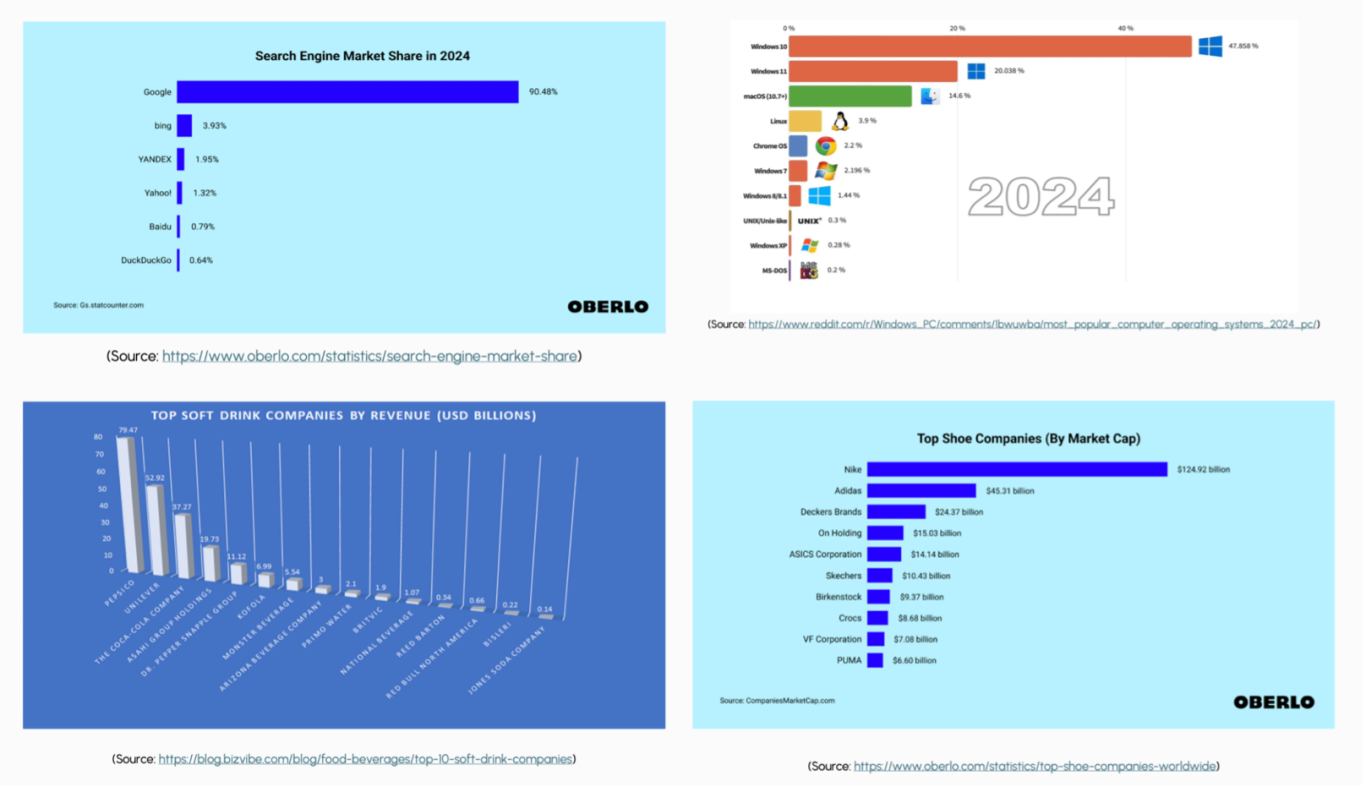
The interesting thing about the LTC applied to companies' market shares is that it consistently shows «L-shape» patterns regardless the market being analyzed, and regardless of whether the market is «hi-tech» or «low-tech».
Following are four examples: two from «hi-tech» (web search engines market, IT operating systems market) and two from «low-tech» (soft drink market, sport shoes market).
One way to determine if a company is a leader, challenger, or survivor is to examine how many resources it invests in its positioning, such as people, time, money, and equipment. The investment needed and the positioning achieved result in what I call the "Positioning Matrix."
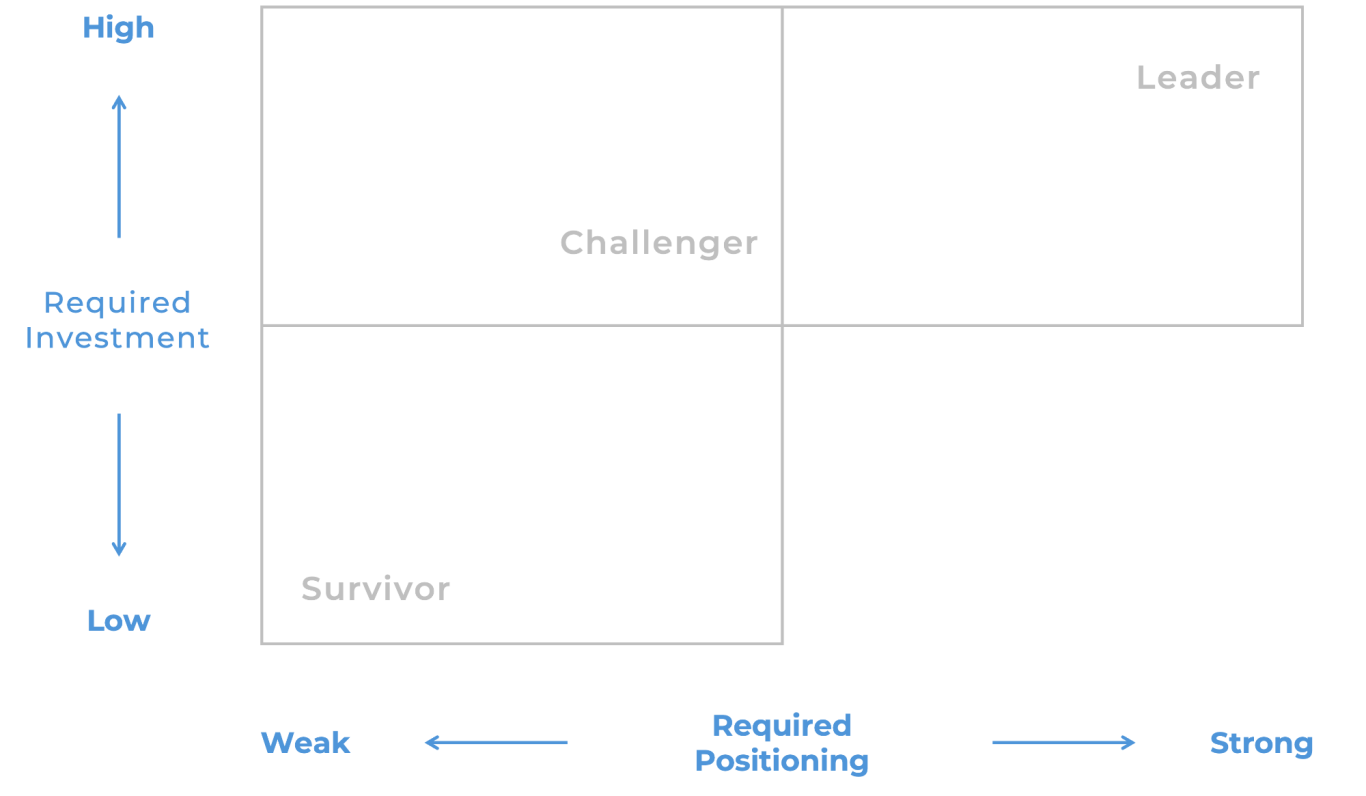
To become a market Leader, a company must invest substantial resources—including personnel, time, money, and equipment—to establish a strong market position.
Though Challengers invest heavily as well, it is less than the leader. While their positioning may not be as robust, it is sufficient to pose a threat to the leader’s standing.
Survivors struggle to maintain their weak market position with limited resources. These are usually small firms with limited geographic reach, which contributes to their weak position in the market.
According to CompanyData BV, there are more than 43.4 million technology companies registered worldwide. This is a truly vast number of businesses.
Many of these companies have a good idea that they have transformed into a product they are trying to sell. Surely, many of these products are good and should sell well, capturing significant market share.
Wouldn't you agree?
Well, no. That's not the case.
And the question is: with so many good products being offered by so many companies in the market, why are there so few leaders — sometimes only one — in any given technological field we might examine? Why are there so few challengers, and why are there so many survivors?
My experience in international sales has taught me that two barriers prevent most companies from moving out of the Survivors quadrant of a positioning matrix and reaching the status of Challenger — or, for that matter — Leader.
I call these the «Know-Who Barrier» and the «Intentions vs. Results Barrier» (referred to as «KWB» and «I/RB», respectively).
The KWB arises when a company looking to sell in an unfamiliar market doesn't know which prospects to contact or which channels to work with. Such a company is likely to make mistakes by attempting to sell directly to unqualified prospects ("false positives") and by selling indirectly through channels that promise sales but ultimately fail to deliver.
Why do so many companies trying to sell abroad make so many mistakes while trying to do so directly to prospects and indirectly through local channels?
Because of the BKW barrier, which I will explain below.
Aristotle stated that human beings are «social animals».
We need to live in groups and interact with others, such as family, friends, and colleagues.
By our very human nature, we strive to be accepted by the people who influence our well-being and the goals we wish to achieve. To this end, we try to present our best selves while concealing our weaknesses.
The same applies in reverse: others also try to show us their best side while hiding their worst.
This socialization strategy is particularly evident in the business world.
When we form partnerships with local channels in unfamiliar markets, this «socialization» strategy can work against us. No channel will speak poorly of itself, and we won't reveal our weaknesses either.
This creates a problem because we can never know in advance whether the channel we’ve chosen to sell our product will actually be capable of doing so—that is, whether their intentions will translate into real results. In other words, the BKW barrier leads to another barrier: the I/RB (Intentions vs. Results Barrier).
Before describing the I/RB, however, I will discuss another issue that exacerbates the negative impact of both. I call this the "Good Channel Paradox": A good channel doesn't need us to survive, and a channel that does need us isn't good.
I’ll explain this below.
What is a «good» channel?
A good channel sells before we meet them. They have clients whom they must serve and support, which alters their agenda, often without prior notice.
They have many prospects for the products they are already selling. It is much easier to sell to these prospects than to sell new services or products, such as ours. For the channel, our products are «question marks» (will the channel be able to sell them? How long will it take? What will the volume be?
Therefore, a good channel will most likely not dedicate its valuable resources (people, time, money) to selling «question marks» with the intensity we would like, especially when starting sales in a market with few or no customers. To get the first customers, the channel ought to invest significant resources.
A good channel will surely continue to allocate most of its resources to selling products that maintain their operations. Although we don't like to admit it, a channel like this doesn't need us to survive, so we can't demand the level of dedication we need (beyond what we've signed on paper, which usually doesn't have much persuasive force to change resource allocation priorities).
Now, what is a «bad» channel?
It is a sales channel that either fails to sell its current products or sells them very little and inconsistently. Such a channel may be eager to form a commercial partnership with us, hoping that our product will enable them to improve their sales performance (and their bank balance).
In this context, extrapolating from past performance can be an effective way to rule out these types of channels early on. If a channel cannot sell its current offerings, the problem likely lies with the party attempting to sell them, not the products themselves. In other words, this channel will likely fail to sell our product, leaving us with wasted time, money, and effort.
The BKW barrier can prevent us from distinguishing a «good» channel from a «bad» one. The I/RB leads us into the «good channel paradox»: If we partner with a «good» channel, they may intend to sell our product, but they will likely fail to do so at the expected volume for the reasons described above. Conversely, if we partner with a «bad» channel, they may have the best intentions, yet their results will be poor... the I/RB barrier in action.
I developed my sales methodology with the specific goal of neutralizing both the BKW and I/RB, and, by extension, the Good Channel Paradox.
The following section describes my four-stage method for selling in target markets within a relatively short timeframe, including the tasks, objectives, and milestones to be met.
My method involves guiding the company that hires me into a fourth quadrant of the positioning matrix, which is not occupied by the leader, challenger, or survivor. Let's take a look:
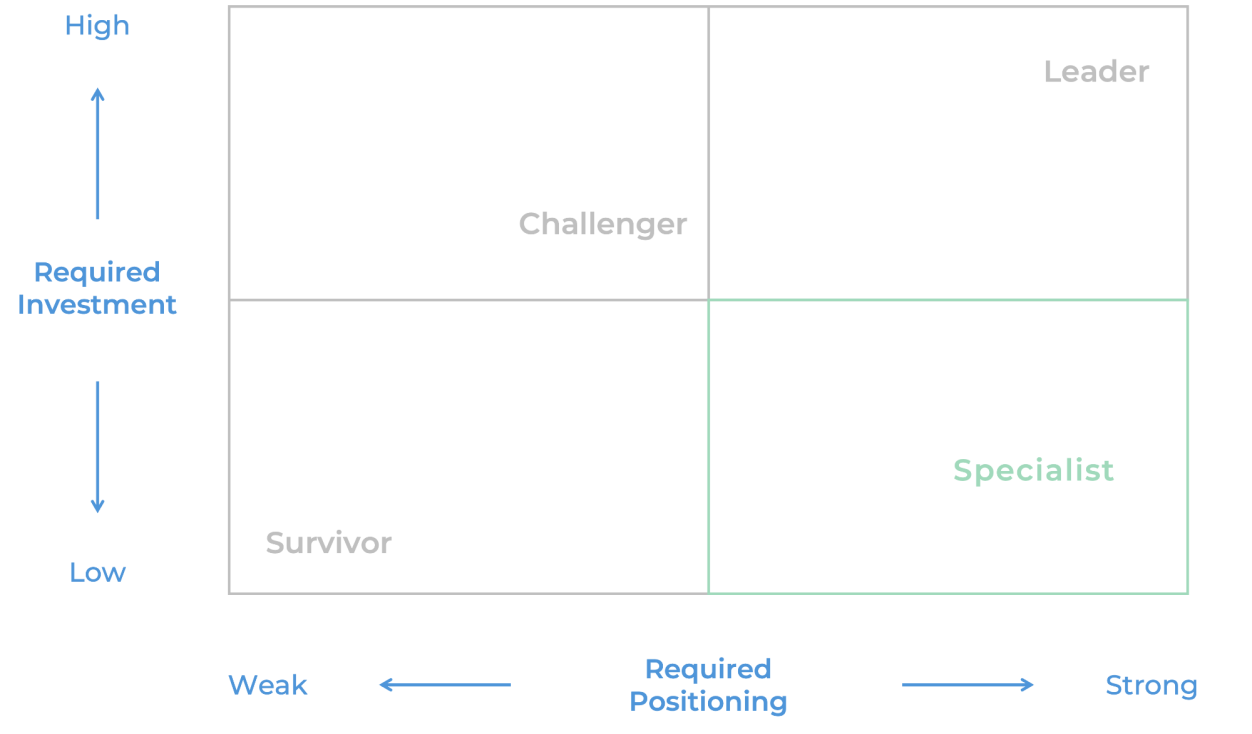
A generalist company operates under a product-centric, mass-sales-oriented business model. It seeks to maximize efficiency and increase production volume. In short, it sells the same product to many different customers. It cannot tailor-make its products to suit each customer's needs and individual preferences.
McDonald’s and SAP are two examples of successful generalist companies.
At McDonald’s, for instance, you cannot order a burger from «Combo 1» with the side dish from «Combo 2», nor can you swap the burger in a hamburger-based combo for a fish-based sandwich.
Similarly, you couldn't ask SAP to install its SAP S/4HANA system and incorporate dashboards from Oracle Fusion Cloud or another ERP system.
If you are a McDonald’s customer, you must settle for a specific combo meal (with no option to mix and match components). If you are an SAP customer, you must learn to use and adapt to the S/4HANA dashboards and functionalities (a far from trivial task, incidentally). In other words, you as a custoemr of a generalist must adapt to their products, instedad of their products adapting to you.
Unlike a generalist, a specialist offers the market something special.
This quadrant offers the advantage of a strong positioning for the company while requiring a relatively small investment in resources.
My sales method does not focus on market leaders or challengers, as they do not need my help to increase their sales (though there are always exceptions that prove the rule).
Instead, my method focuses on companies that are trying to survive. It also focuses on specialists.
Whether your company is a survivor or a specialist, my method can help you increase your sales volume.
It is based on my 25+ years of experience selling technology in international markets. It's also based on common sense.
It consists of four stages. The initial phase lasts approximately 28 weeks.
I will describe it in the next section.