
The Positioning Matrix and my 4-stage sales approach
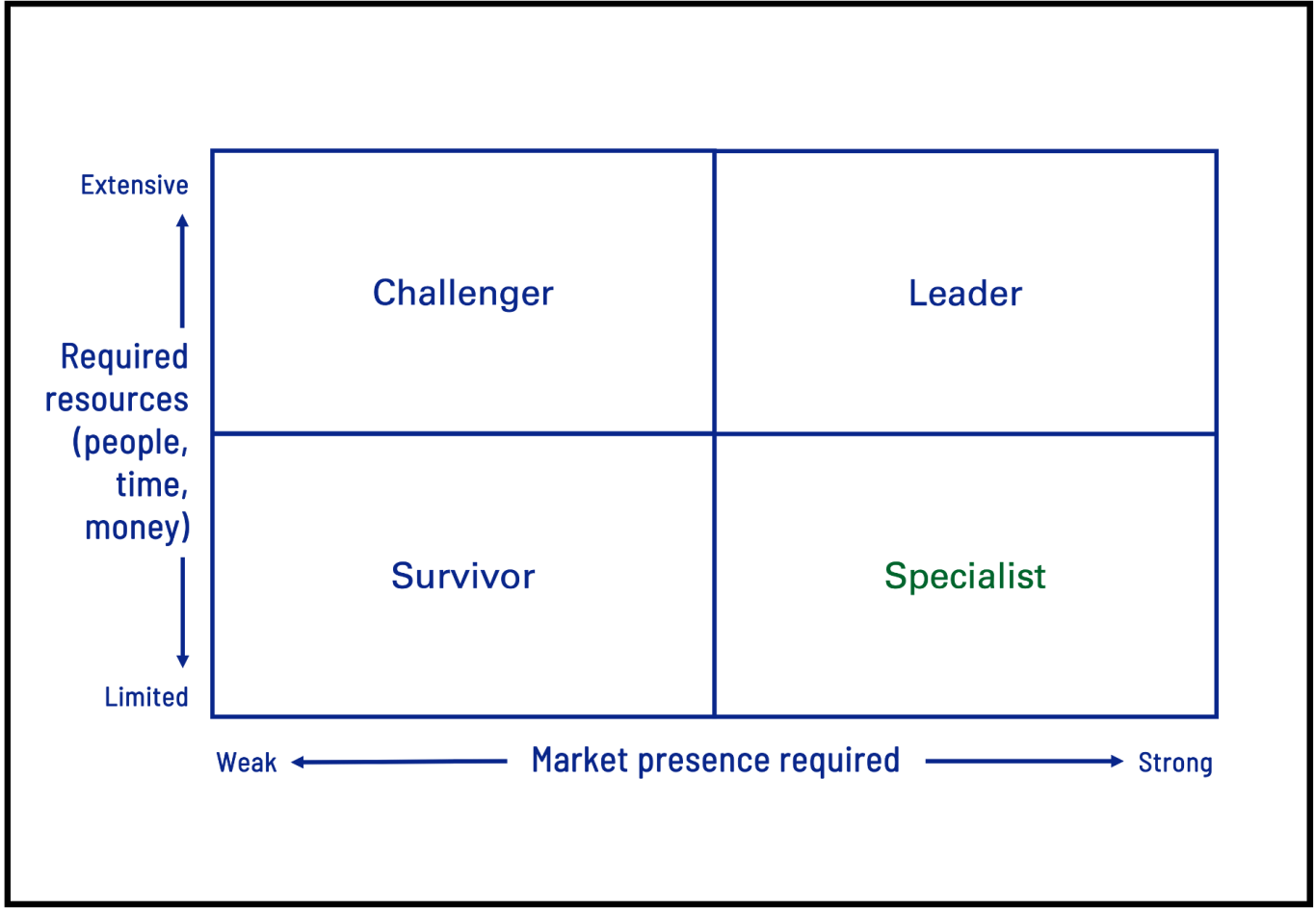
My 4-stage sales approach can drive your company to a fourth quadrant of the positioning matrix: the «Specialist» quadrant.

A Specialist is a company whose solutions are perceived by the market as having unique advantages over competition, be it from companies occupying the Leader, the Challenger or the Survivor positions.
Uniqueness in your sales proposition to the Target Market doesn't need to be based on some feature of your solution, at least, not exclusively.
It's typically based on one or more of the following key success factors («KSF») as compared to competition:
KSF #1: a unique intrinsic and verifiable advantage of the vendor's products and/or services.
KSF #2: a competitive advantageous reach to prospects in the Target Market (it may be in one vertical sector or in several).
KSF #3: a competitive advantage the local channel has over their competitors in the Target Market.
KSF #4: existing customers of the vendor that are global, with subsidiaries in the Target Market that could buy their solutions.
I take care of finding KSF in the Target Market and combine them in a sales mix to favor your company's solutions sales.
The goal is that your company be perceived by the Target Market as having «something special» that differentiates it from competition... in other words: as a Specialist.
The Specialist market positioning is the best one a company whose brand and products are unknown or barely known in the Target Market can reach.
This positioning doesn't require significant investment from the vendor of their valuable resources (people, time, money), while at the same time, it allows the vendor to be visible to customers in the Target Market, whereas a Survivor is like another «water drop in the ocean».
My 4-stage sales approach
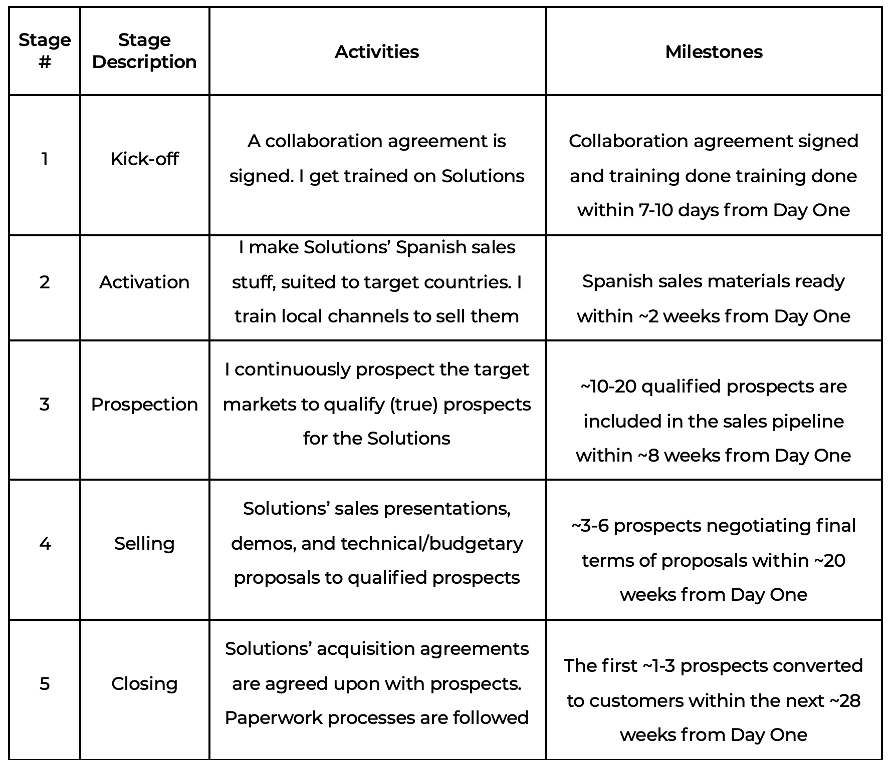
To build a Specialist positioning for your company in the Target Market, I apply my 4-stage sales approach, which is summarized as follows:
Plan Kick-off
Collaboration agreement signed with your company (using a template for this purpose).
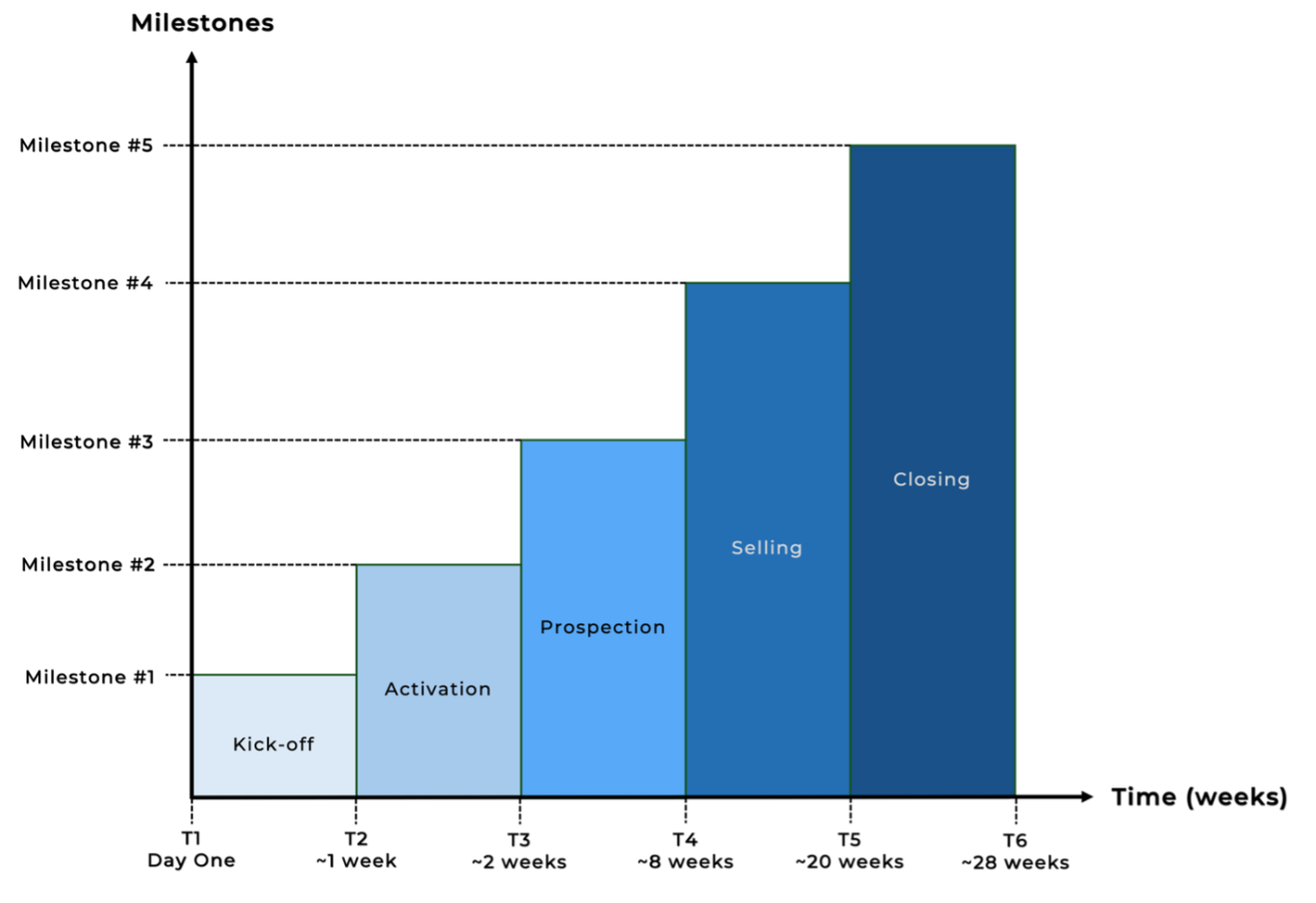
I get trained on your solution to be able to perform sales and demo sessions to qualified prospects, to make Spanish marketing materials, etc. Estimated time to complete this stage: within 2 weeks from Day One, defined as the date of signature by both parties of the collaboration agreement, which will be the effective date of my sales plan’s kick off.
Pipeline Building
Continuous market prospection to already identified (and qualified) prospects to raise their interest in your solutions.
Prospection performance data is reported to your company on an ongoing basis.
Industry-proven prospects qualification tools are used – BANT and MEDDPICC – to prevent «false positives» to be included in the sales pipeline and to feed it only with real sales opportunities.
Estimated time to complete this stage: within 2+ weeks from Day One and continuously from then on.
Qualified Selling
Sales presentations and live demos performed to qualified prospects. Technical and budgetary proposals are made (in Spanish and customized to target prospects). If applicable, POC (proofs of concept) are performed as part of presales activities to close deals. My hybrid profile (technical education and sales specialization) allows me to fill two roles: technical support and sales, thus saving your company labor costs while speeding up sales cycles.
Estimated timeframe for this stage: within 10 weeks from Day One.
Deals Closing
Customer's contract terms to acquire and use your solutions are negotiated and agreed upon, always in accordance with your company's policies on this regard.
My +25 years of experience in selling to tier-1 and tier-2 customers in LATAM and other regions will contribute to speed up paperwork and decision processes at customers’ organizations, thus shortening the presales cycle.
Estimated timeframe for this stage: within z28 weeks from Day One.
IMPORTANT: I do not work alone. I have a network of well-positioned local channels in several Spanish-speaking LATAM
countries, each with their own technical and commercial resources. and excellent reach to customers in their
respective countries. I supervise these channels and work with them on the field to deploy my 4-stage sales
method. In other words: my 4-stage sales approach does not hinge upon a single person (me) but on multiple,
skilled technical and commercial resources. This warrants the expected results in the expected timeline.
Timeline of my 4-stage sales approach

Some customers
These are some of the customers where I have deployed an IT and/or OT and/or IoT project.
All of them are tier-1 or ttier-2.
My experience with IT, OT and IoT technologies
- LPWAN (Low Power Wide Area Network) technologies
- SCADA (Supervisory Control And Data Acquisition) systems
- IT Security and Governance solutions
- GRC (Governance, Risk management and Compliance) software for SAP HANA, Oracle EBS, and other platforms
- Application Access Governance and Continuous Controls Monitoring solutions
- Cybersecurity Application Controls and Dynamic Access Control solutions
- Automatic Meter Management (telemetry, M2M software and hardware solutions)
- Predictive Maintenance solutions
- IT/OT Continuous Monitoring platforms
- Smart City applications
- Fixed and Mobile Assets Tracking solutions
My compensation model
To deploy my 4-stage sales approach I charge a Temporary Fixed Monthly Fee (TFMF) and a Closed Deals-related Variable Income (CDVI).
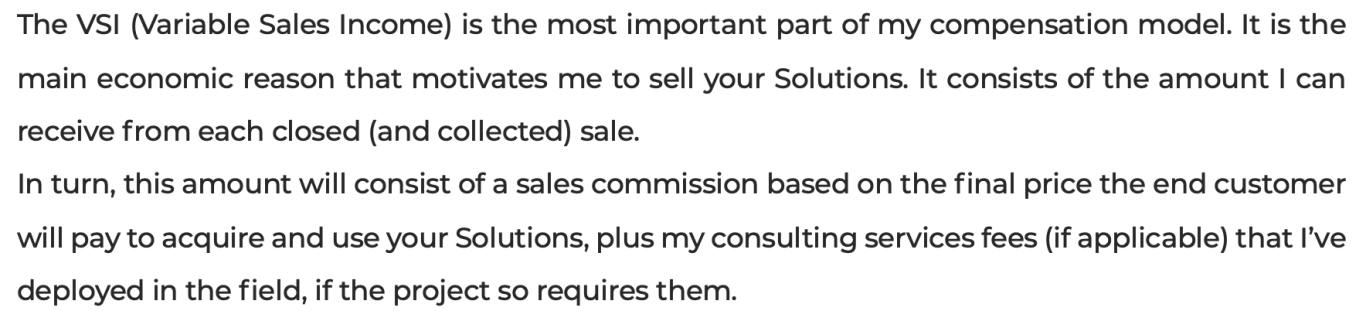
My CDVI is a variable amount that depends on each sale, and it is usually the margin I add to the money the vendor expects to receive (hereinafter «Vendor's Compensation Amount» or «VCA» for short) from the deal once it's closed and collected from the end customer. In other words: End Customer Price = VCA + CDVI.
My CDVI is generally (much) be higher than my TFMF, as you'll see shortly below where I describe the TFMF.
My TFMF is temporary because I stop invoicing it when either of these two conditions occurs (whichever happens first):
Condition #1: I close a deal within 28 weeks or less from Day One (see timeline above), and my CDVI is equal to (or higher than) my TFMF. In such case, I'll invoice your company only my CDVI, not my TFMF.
Condition #2: there elapse 28 weeks (i.e., 7 calendar months) from Day One, and there still are no closed and collected deals so far. In such case, I'll stop invoicing your company my TFMF from the eight-calendar month from Day One onwards, even if the first closed and collected deals will come somewhen thereafter.
Therefore, in either case, my TFMF will cease to be your only fixed cost to pay my 4-stage sales approach anytime upon condition #1 («best case») or after elapsed 7 months upon condition #2 («worst case»).
My TFMF is € 1,850.00 (one thousand eight hundred and fifty euros) per month.
This means even if condition #2 («worst case») occurs instead of condition #1 («best case»), your total fixed cost to implement my 4-stage sales approach will be € 12,950.00 (twelve thousand nine hundred and fifty euros).
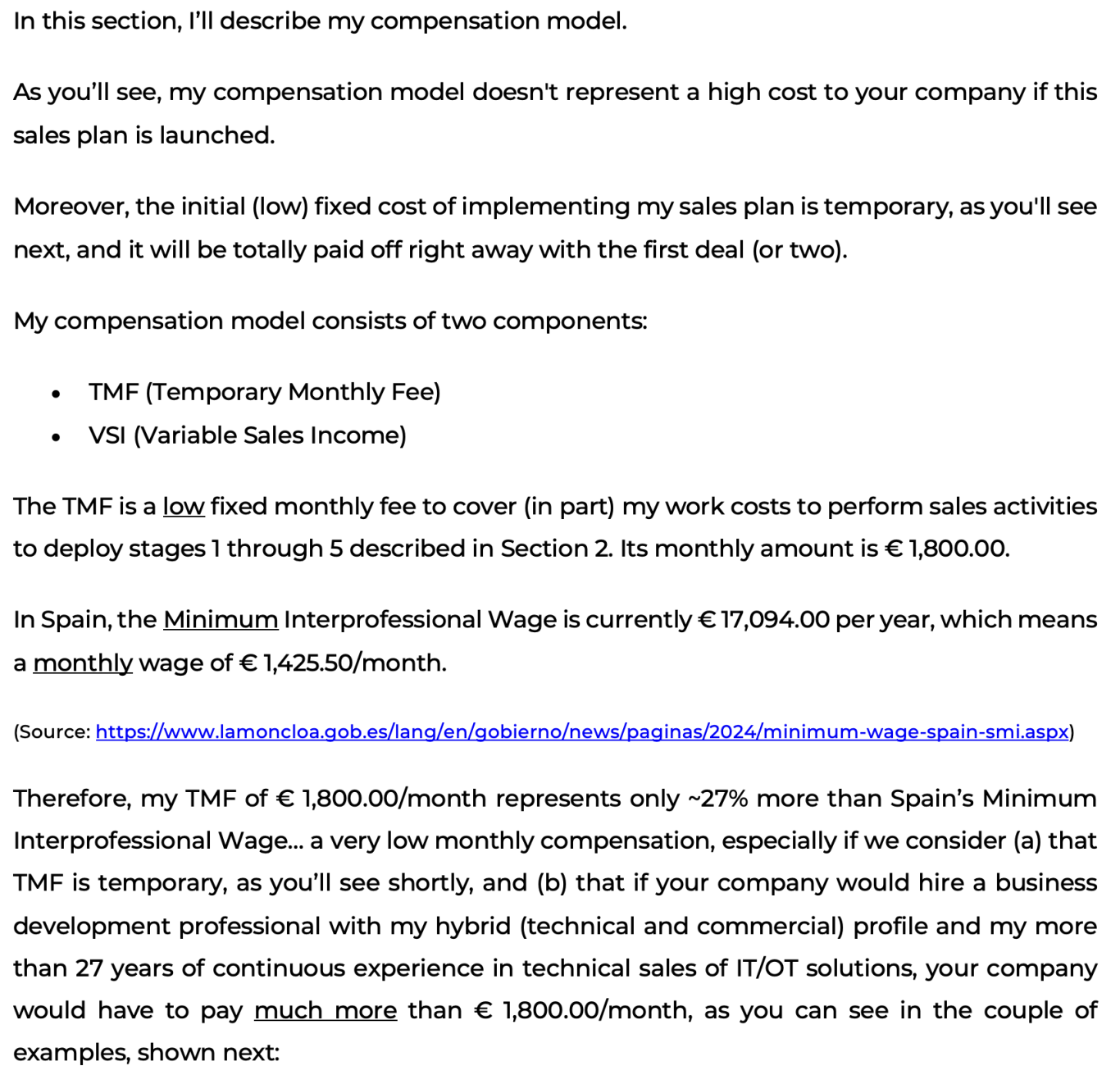
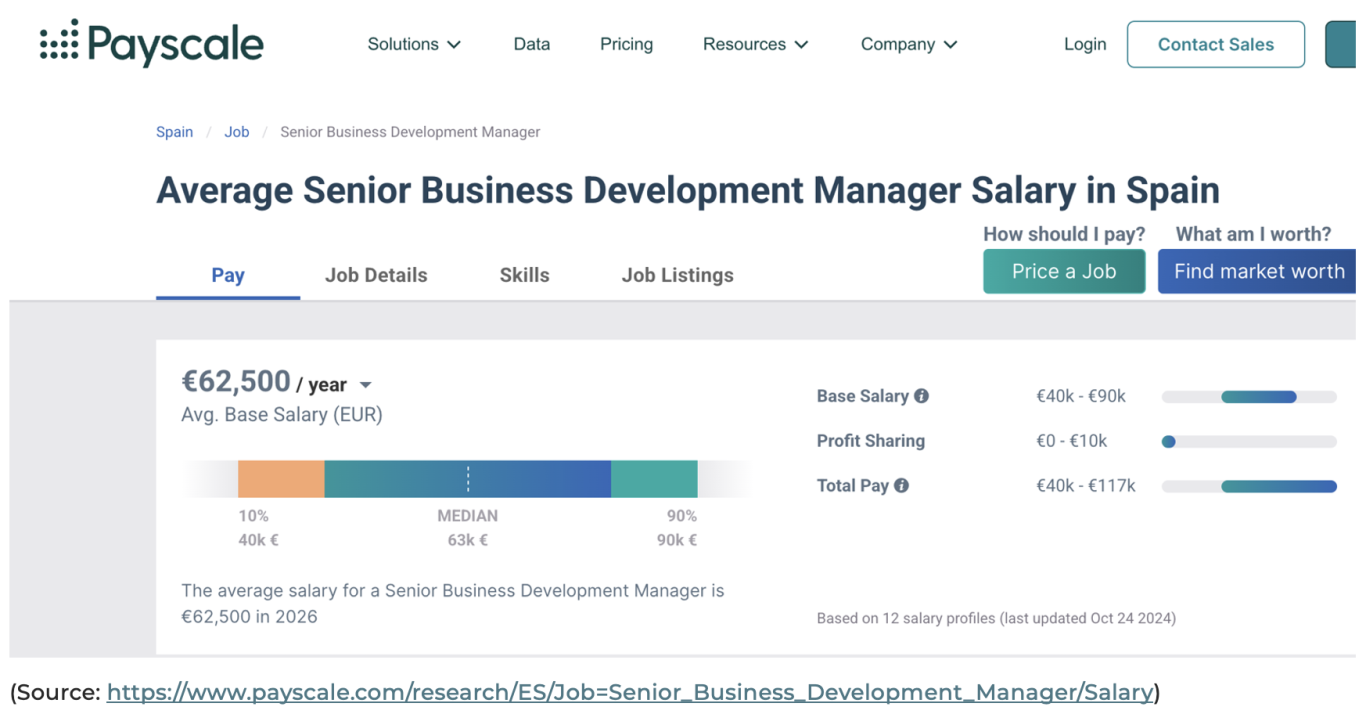
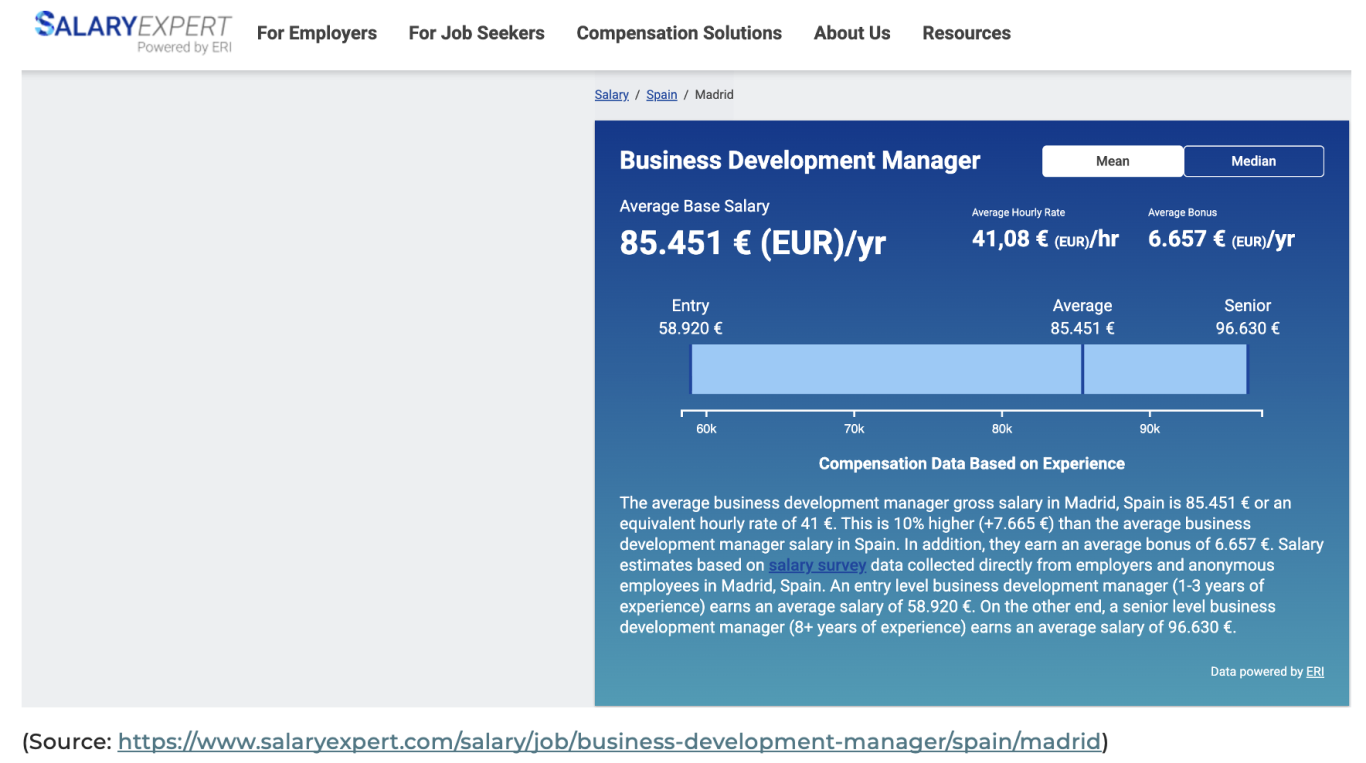
I've purposely set my TFMF (really) low, as € 1,850.00 is (really) significantly lower than the average, low entry and top level salaries for salespersons in the USA or Spain (I live in Spain):
$74,800 / Annual = $ 6,233.33 / month ≈ € 5,400.00 / month (based on 8351 salaries)
The average Salesperson in United States of America is $74,800 per year or $37.85 per hour. Entry-level positions start at $49,375 per year ($ 4,114.60 / month ≈ € 3,590.00 / month), while most experienced workers make up to $120,375 per year ($ 10,031.25 / month ≈ € 8,690.00 / month).
(source: https://www.talent.com/salary?job=salesperson).
Technical Sales Specialist Salary in Spain
Senior level: € 72,000.00 / year = € 6,000.00 / month.
(source: https://www.salaryexpert.com/salary/job/technical-sales-specialist/spain)
My compensation model has at least three cost-related advantages for any company whose brand and solutions are unknown or barely known in the Target Market, when comparing it against typical compensation packages of people doing the same job I do to deploy my 4-stage sales approach, namely:
- As an external consultant (not an employee in your payroll), your company saves several labor costs, such as paid sick leave, paid vacation, medical insurance, etc.
- My hybrid profile (technical expert and sales expert) allows me to address the roles of a technical support for a salesperson, the roles of a technical salesperson, and several roles of a marketing person (for instance, marketing writing to make Spanish-based collateral marketing and sales materials). If your company had to hire and pay an individual person to cover each of these three jobs, you'd need to pay three salaries, whereas with my approach you'll only have a temporary fixed cost that in addition, is much lower than the labor market accepted salaries.
- I know the Target Market since it's my core market where I'm putting my focus since the beginning of my sales career up to date. This first-hand knowledge will ensure a fast time-to-market for your solutions in the Target Market while avoiding costly trial-and-error attempts to sell your solutions in these territories.
NOTE:
I do not work on a «success fee only» compensation model. In other words, I always charge my TFMF during the first 7 (seven) calendar months ... or less than this period if condition #1 (see above) occurs.
My TFMF is purposely low to represent a minor (and temporary) fixed cost for companies that hire my sales services, and it serves to cover a small part of my investment (in time, which means money too) to perform stages 1 through 4 of my sales approach.
Besides, there's an important conceptual difference between the TFMF and the CDVI:
TFMF is my (temporary) compensation for my time to do my job to bring closed deals for your company.
CDVI is my reward for a job well done (i.e., for closed deals brought to your company).
Conceptually, compensation ≠ reward...
....in my humble opinion, no worker should give up just for free her/his most valuable and irreplaceable resource (part of her/his life time) ...i.e., without some fixed compensation for her/his invested time.