

An innovative sales approach to sell your solutions
All companies on this planet belong to either of three groups:
- Leaders. A company whose market share (in sales volumes) is much higher than the competition's. The company's brand and products are known and enjoy high demand.
- Challengers. A company with a big market share, yet smaller than the Leader's. Their products are being adopted at a pace that may threaten the Leader's positioning.
- Survivors. A company whose market share is negligible compared with both the Leader's and the Challenger's. Their products and brand are unknown or barely known in the target territory, and their sales (if any) are unsteady and unpredictable.
The Long Tail Curve
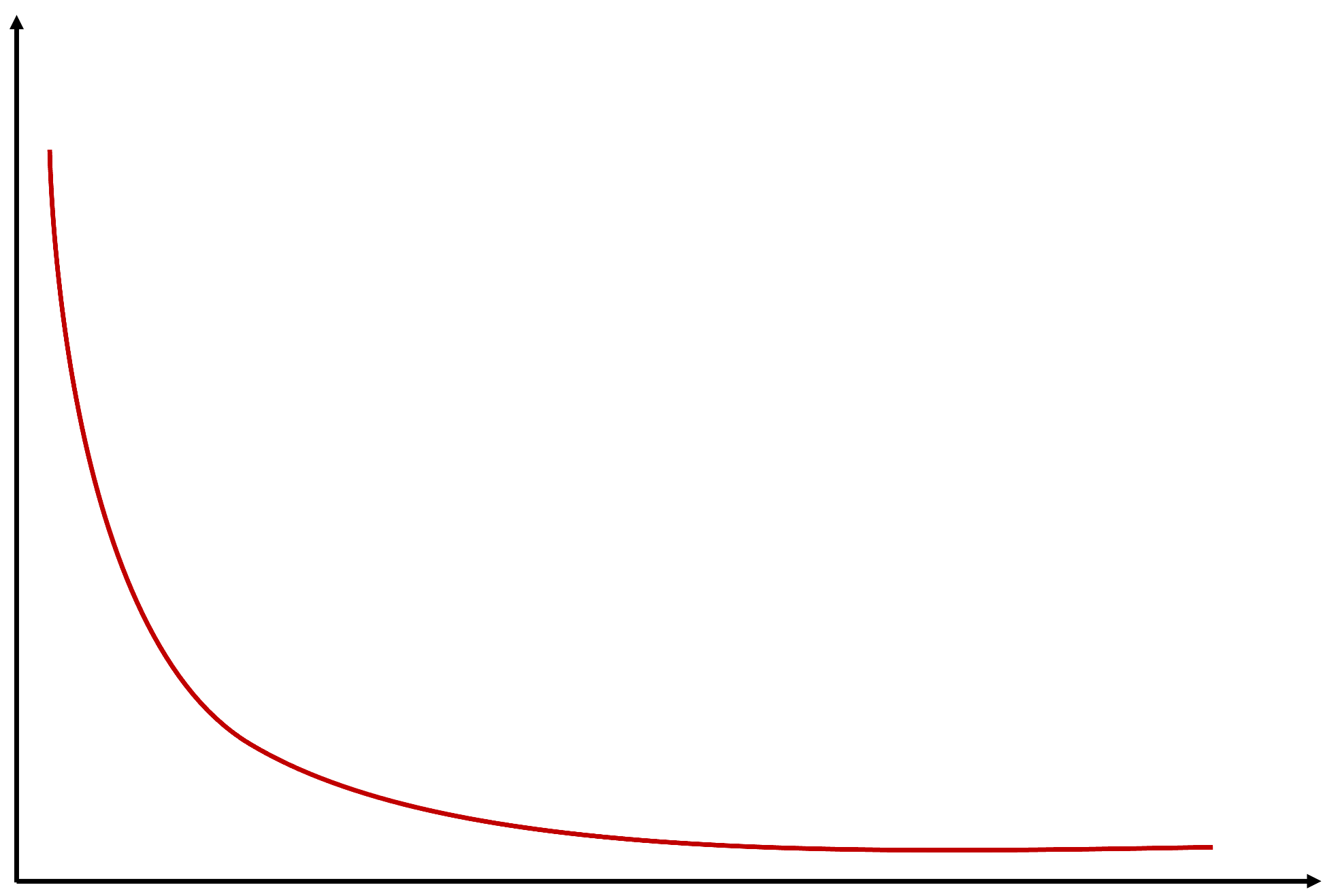
The so-called «Long Tail Curve» («LTC», for short) is a term from economics science, describing a Cartesian graph (a vertical axis «Y» and a horizontal axis «X») where many events concentrate in a very narrow portion of the «X» axis and reach a high value at the «Y» axis. Outside that narrow part at the «X» axis, the number of occurrences sharply decreases, showing much smaller values at the «Y» axis along the «X» axis.
The following chart shows the LTC:
If we plot on the LTC chart the place occupied by Leaders, Challengers and Survivors on the «X» axis, according to their market share measured in sales volumes («Y» axis), we will obtain the following chart:
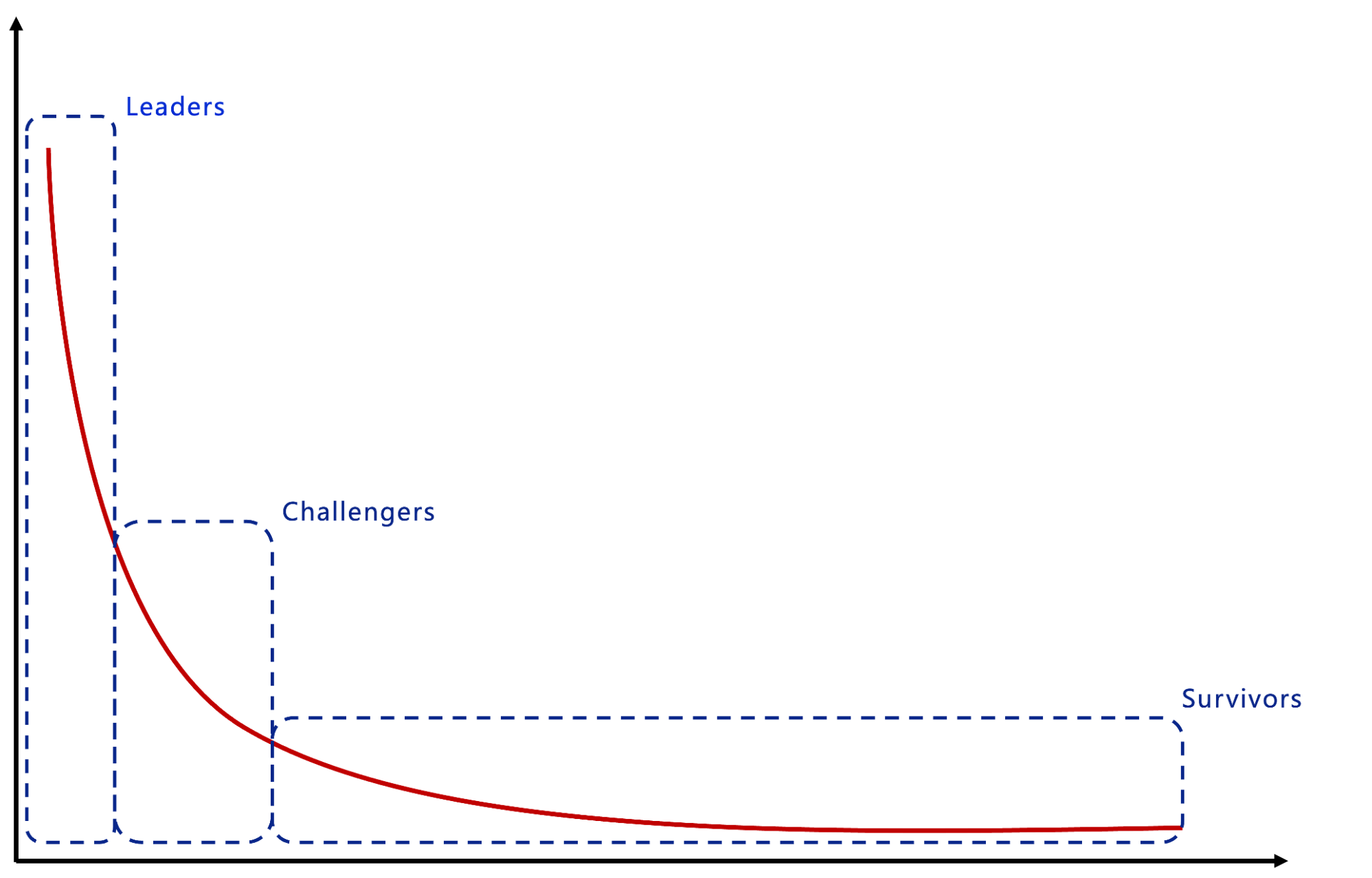
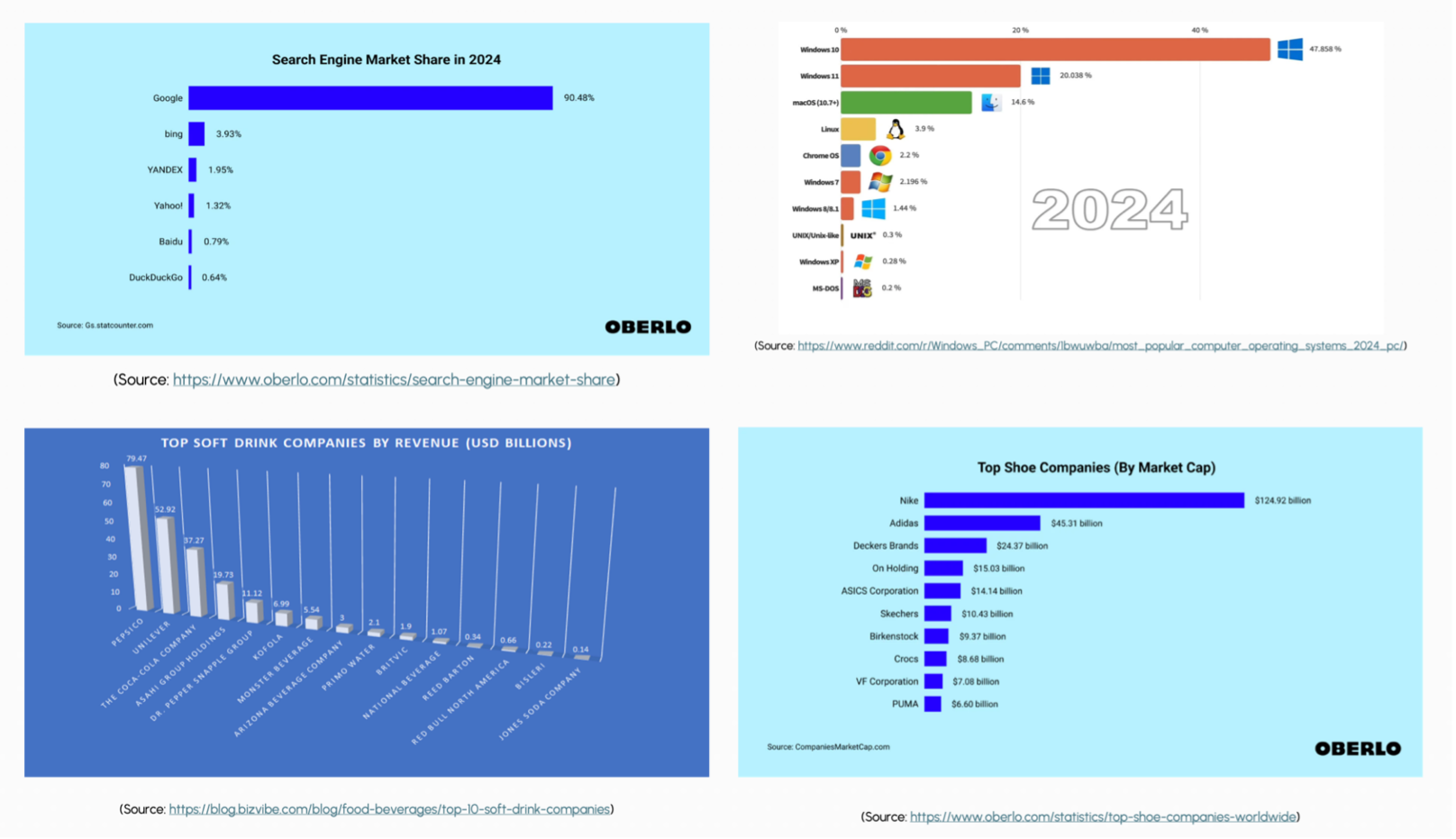
As we see in Figure 1, one or a few companies are enjoying the Leader position, followed by a small number of companies in the Challenger position, and then a lot of companies in the Survivor position. The interesting thing about the Long Tail Curve applied to the market share of competitors in anygiven market is that it consistently shows a similar «L-shape» pattern, regardless of the market or business sector being analyzed, even regardless of whether the market is «hi-tech» or «low-tech».
Do you want real-life cases?
Following are four examples: two from «hi-tech» (web search engines market, IT operating systems market) and two from «low-tech» (soft drink market, sport shoes market).
Two barriers that ruin sales: the «Know-who» barrier and the «Intentions vs. Results» barrier
If your company is neither a Leader nor a Challenger, but a Survivor... at least in Spanish-speaking countries (the territory we are considering), keep reading... if you are a Leader or a Challenger, my sales approach may still be useful in specific cases.
Remember: a Survivor's products and brand are unknown, or barely known, in the target market. Things get more complicated if the company has not sold anything yet in these markets (there's no sales performance history to make informed decisions).
Add to this the language and cultural barriers if the Survivor's home country is not Spanish-speaking.
A Survivor will rarely choose to establish its own branch in these foreign and distant markets, staffed by employees whose salaries and labor costs must be paid, plus the office's monthly expenses.
Two reasons prevent Survivors from establishing on their own in such territories: (a) a limited budget for developing business in faraway territories; (b) high uncertainty about sales performance in these countries.
A Survivor has typically two options to sell in these territories: (1) to sell directly from their home country to prospects in these territories or (2) to partner with local distributors to resell their products in these markets.
Why both options almost always end in a frustrating waste of time and money is explained next.
- The «Know-who Barrier»
Option (1) will fail due to a «bidirectional lack of knowledge».
On the one hand, Survivor’s company brand and products are unknown or barely known in the (targeted) markets, so the company and its products are virtually invisible to potential customers… just like another «water drop in the ocean». On the other hand, a Survivor does not know «who's who» in targeted markets: all they know is gathered from external sources, such as the Internet, which are often outdated and/or incomplete.
This two-way lack of knowledge maximises their chances of failure.
- The «Intentions vs. Results Barrier»
Aristotle said that humans are social animals, meaning that we are designed by nature to live in groups and interact with other members of those groups: family, friends, and co-workers, and with other groups.
Fulfilling our life goals depends on others, and these dependencies apply to our business activities.
It is part of our human nature to strive to be accepted by social groups that are key to our success (and survival), so we'll always try to show others the best version of ourselves, omitting our weaknesses. The same goes for others when they interact with us: they show us their best version while trying to hide their worst.
This socialisation strategy is a fact of life, and we must also account for it when we establish business partnerships with channels in faraway markets. In other words, no potential partner will speak badly about themselves in front of us, and we won't tell them about our weaknesses either.
And with this fact of life, we have a problem: we never know beforehand if a partner we've chosen to sell our products in their market will sell them at the end of the day, that is, if their intentions will turn into results.
The partner might be doing an excellent job selling other products in their portfolio, but might do poorly at selling ours: a good sales performance history with someone else’s product does not warrant a good sales performance with ours.
Adding to this is another problem, which I call the «effective partner paradox».
An effective partner is selling well before we contact them. A partner that sells well is very busy serving their customers, has many qualified prospects in the sales pipeline (for their existing portfolio), and has other daily issues to deal with. This means a heavy workload that lets the partner little or no room to address other things and invest their valuable resources (people, time, money) in more things… like positioning and selling a new product (ours).
Worse yet, our product is a «question mark» for an effective partner: they have not sold it yet, so they cannot know its sales performance... i.e., high uncertainty that will discourage them from promoting and selling our product.
This vicious cycle is what I call the «effective partner paradox», a vicious cycle that proves very difficult to break.
All these factors compound to build this high «Intentions vs. Results Barrier», the second cause of failure of most plans to sell in Spanish-speaking countries.
The Positioning Matrix
If we plot on a matrix diagram the position of Leaders, Challengers and Survivors considering two parameters – required resources investment (people, time, and money) and the market positioning required – we get the following figure:
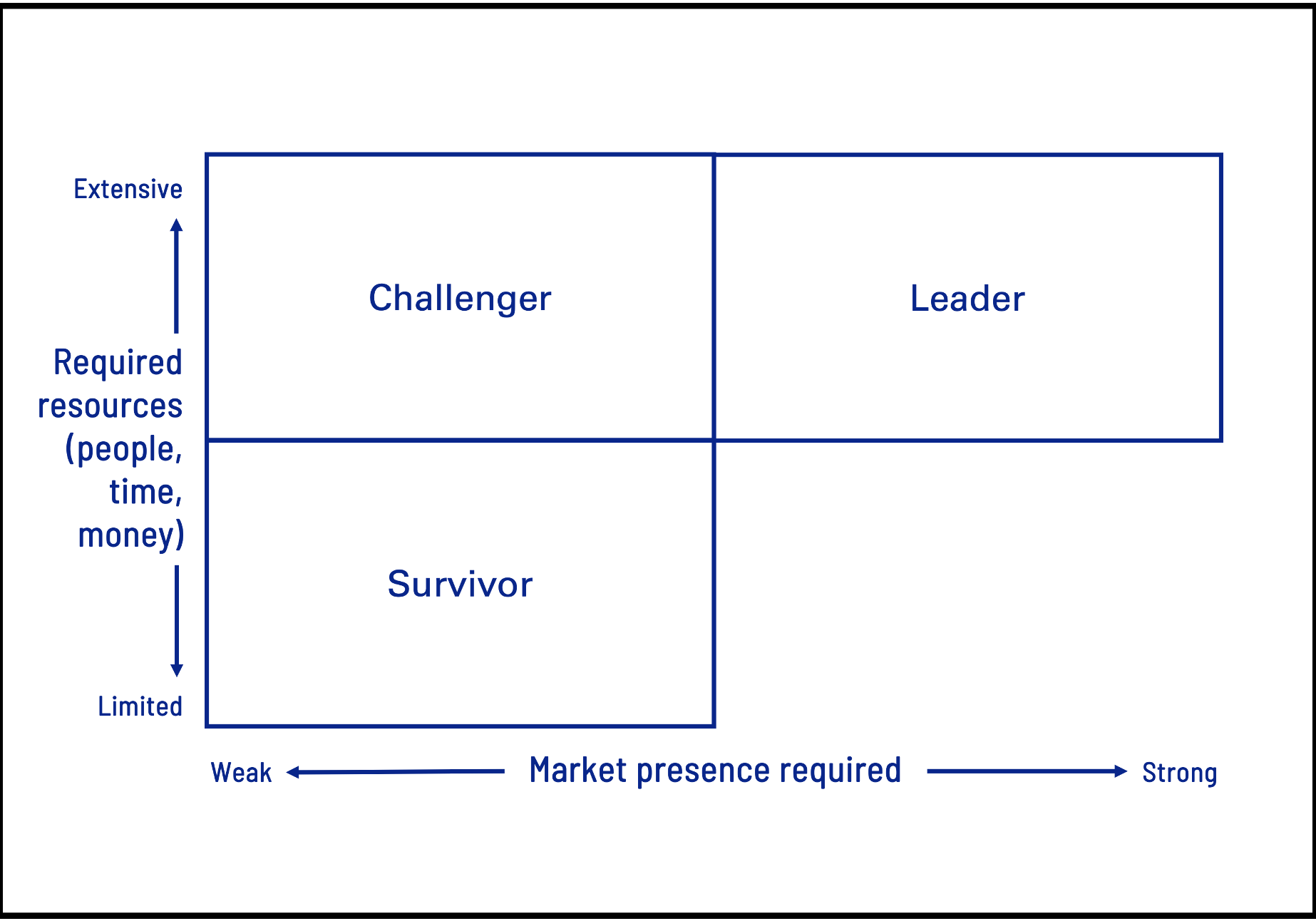
The Leader requires extensive resources (people, time, and money) and must be strongly positioned in the target market. Therefore, it occupies the upper right quadrant of the matrix.
Challengers also require extensive resources, yet not at the Leader’s level, and their positioning may be weaker or stronger, but not as strong as the Leader’s, so they usually occupy the positioning matrix upper left quadrant.
A Survivor cannot afford an extensive investment of its (scarce) resources, so its investment is quite limited. In part due to their limited resource investment, Survivors' positioning in the matrix is typically weak, at best, thus occupying its low-left quadrant.
Now, if your company brand and products are unknown or barely known in some of the Spanish-speaking countries where I’m proposing this sales plan to you, my sales approach proposes that your company occupy a fourth quadrant in the positioning matrix, and to do it in ~28 weeks (or less) from the date of my sales plan kick-off
My sales approach can help to do it.
This is the subject of the next section: Approach.